Website Conversion Rate Optimisation: How to Turn More Visitors into Customers
- November 1, 2026
- Uncategorized
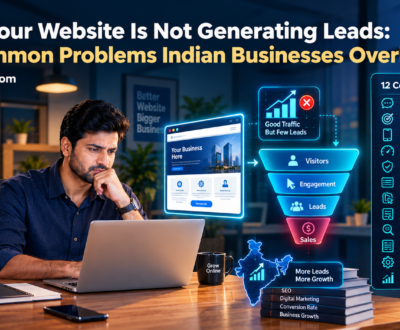
Your website is getting visitors. People are clicking your ads, finding you through Google, and exploring your products or services.
But there is one problem.
Visitors are coming in, but enquiries and sales are not growing at the same pace.
For many Indian small and medium-sized businesses, the immediate reaction is to spend more money on advertising, publish more content, or invest in SEO.
Sometimes, more traffic is exactly what the business needs. But sometimes, the real problem is what happens after a visitor reaches the website.
Visitors may not understand your offering. They may struggle to find the information they need. They may not trust your business enough to enquire. Or the process of taking the next step may simply be too complicated.
This is where website conversion rate optimisation (CRO) becomes important.
In this guide, we will explain what conversion rate optimisation means, why websites fail to convert visitors, which improvements businesses should prioritise, and how to build a practical 30-day CRO plan.
What Is Website Conversion Rate Optimisation?
Conversion rate optimisation is the process of improving a website or landing page so that a higher proportion of relevant visitors complete a desired action.
That action depends on the business model.
For an ecommerce business, it might be completing a purchase.
For a B2B company, it might be submitting an enquiry form, booking a consultation, or requesting a quotation.
For a clinic, it might be requesting an appointment.
For a professional services firm, it might be scheduling an introductory call.
The objective is not simply to increase clicks. It is to help the right visitors take meaningful actions.
How Do You Calculate Website Conversion Rate?
A basic conversion rate formula is:
Conversion Rate = Number of Conversions ÷ Number of Relevant Visitors or Sessions × 100
Suppose a business website receives 5,000 sessions in a month and generates 100 enquiries.
If sessions are the chosen denominator:
Conversion rate = 100 ÷ 5,000 × 100 = 2%.
Now suppose the business improves its website and generates 150 enquiries from the same 5,000 sessions.
The conversion rate becomes 3%.
That is an increase of one percentage point, or a 50% relative increase in the conversion rate.
This is an illustrative example, not an expected industry benchmark or guaranteed result.
The calculation also depends on what you measure. Sessions, unique visitors, and users are different denominators. Choose one definition and use it consistently when comparing performance.
Why Conversion Rate Optimisation Matters for Small Businesses
Imagine that you are spending money on SEO, Google Ads, social media campaigns, or other marketing activities to attract visitors.
If your website does not help those visitors understand your offering and take action, part of that marketing investment may be wasted.
Improving conversion performance can help you make better use of the traffic you already attract.
1. Get More Value From Existing Traffic
Before increasing your marketing budget, investigate whether relevant visitors are encountering avoidable obstacles.
Improving clarity, trust, usability, and the enquiry process may help more visitors take the next step.
2. Improve Marketing Efficiency
When more qualified visitors convert, the cost per enquiry or acquisition may improve, provided other costs and customer quality remain reasonably stable.
This makes conversion rate an important companion to advertising and customer acquisition metrics.
3. Understand Customer Behaviour
Conversion analysis helps reveal where visitors lose interest, which pages generate enquiries, and what information customers need before making a decision.
These insights can improve not only your website but also your messaging, offers, and sales process.
4. Support Sustainable Growth
More traffic is not always the only answer to slow sales.
A business that improves its website, lead handling, and customer journey may be able to make better use of its existing acquisition channels.
However, conversion optimisation cannot compensate for every problem. Poor demand, an unsuitable offer, weak pricing, or unqualified traffic may require a different solution.
12 Reasons Your Website Is Not Converting Visitors
Before redesigning your entire website, examine the most common causes of poor conversion performance.
1. Your Value Proposition Is Unclear
When visitors land on your homepage, they should quickly understand three things:
- What do you offer?
- Who is it for?
- Why should they consider you?
Many websites use vague headlines such as "Your Trusted Growth Partner" or "Innovative Solutions for Tomorrow."
These statements may sound professional, but they do not necessarily explain what the business actually does.
Compare the following examples.
Vague: "We Help Businesses Grow."
More specific: "We Build WordPress and Shopify Websites for Indian Businesses That Want More Qualified Enquiries and Online Sales."
The second statement communicates the service and audience more clearly.
Your actual value proposition should reflect what your business genuinely delivers. Avoid making promises that you cannot substantiate.
2. Your Website Attracts the Wrong Audience
A website can receive substantial traffic without generating meaningful business opportunities.
This can happen when the keywords, advertisements, social media content, or referral sources attract people who are not looking for your offering.
For example, a company selling premium B2B consulting may receive visitors searching for free templates or basic definitions.
Those visitors may be interested in the topic but not ready to purchase consulting services.
What to do: Compare traffic sources with enquiry quality. Examine the search terms, campaign targeting, landing pages, and actual customer requirements.
The objective is not to attract everyone. It is to attract visitors whose needs match your offer.
3. Your Call to Action Is Weak or Confusing
A call to action (CTA) tells visitors what to do next.
Examples include:
- Book a Consultation
- Request a Quote
- Explore the Collection
- Schedule an Appointment
- Get a Business Audit
- Start Your Free Trial
A common mistake is providing several competing actions without making the primary next step clear.
Another is using vague wording such as "Click Here" when a more descriptive CTA would explain the benefit.
What to do: Give each important page a clear primary action. Supporting actions can still exist, but they should not distract visitors from the main goal.
4. Your Website Is Difficult to Use on Mobile
Many customers discover and evaluate businesses on mobile devices.
If your website has tiny text, overlapping elements, difficult forms, slow-loading images, or buttons that are hard to tap, visitors may leave before completing an action.
Test the actual customer journey on several mobile screen sizes.
Check whether visitors can:
- Understand the offering without excessive zooming.
- Read the content comfortably.
- Find contact details.
- Complete forms easily.
- Navigate product or service pages.
- Reach important CTAs without unnecessary effort.
Mobile usability should be treated as a core part of website design, not an afterthought.
5. Your Website Loads Too Slowly
Website speed affects the user experience and can influence whether visitors continue browsing.
Large images, unnecessary scripts, excessive plugins, poorly configured hosting, and unoptimised code can contribute to performance problems.
Google's Core Web Vitals provide useful performance indicators:
- Largest Contentful Paint (LCP): Measures loading performance. A good target is 2.5 seconds or less.
- Interaction to Next Paint (INP): Measures responsiveness. A good target is 200 milliseconds or less.
- Cumulative Layout Shift (CLS): Measures visual stability. A good target is 0.1 or less.
These thresholds are assessed at the 75th percentile of page visits, with mobile and desktop evaluated separately.
Use PageSpeed Insights and relevant analytics to identify specific problems instead of assuming that a redesign will automatically improve speed.
6. Your Website Does Not Build Enough Trust
Visitors may hesitate to enquire if they cannot establish whether your business is credible.
This is particularly important when a purchase involves significant money, an ongoing business relationship, healthcare services, or personal information.
Trust signals may include:
- Genuine customer testimonials.
- Relevant case studies.
- Accurate company information.
- Clear contact details.
- Product specifications or service deliverables.
- Transparent pricing or quotation processes.
- Professional credentials where relevant.
- Clear privacy, refund, and service policies where applicable.
Use authentic evidence. Fabricated reviews, exaggerated claims, and unsupported results can undermine credibility.
7. Your Forms Ask for Too Much Information
Every additional form field creates another task for the visitor.
If someone wants to request a consultation but must complete a lengthy questionnaire before contacting you, they may abandon the process.
Collect the information required to take the next step, not everything you might eventually want to know.
For an initial B2B enquiry, a form might ask for:
- Name.
- Business email or phone number.
- Company name, where relevant.
- Service required.
- A short description of the requirement.
More detailed qualification questions can follow once the visitor has expressed interest.
The appropriate form length depends on the value of the offer and the level of qualification required.
8. Your Offer Does Not Match Customer Intent
Different visitors arrive with different levels of awareness and buying readiness.
Someone researching business automation may not be ready to purchase a full implementation project.
Someone comparing Shopify developers may be ready to request a proposal.
A website that pushes every visitor towards the same sales conversation can miss opportunities.
What to do: Match the CTA to the visitor's likely intent.
Educational content can offer a relevant guide or assessment. Service pages can encourage consultations or quotations. Product pages can make purchasing information and checkout actions clear.
The aim is to provide a logical next step rather than force every visitor into the same funnel.
9. Your Landing Page Is Distracting Visitors
A dedicated landing page should support a specific campaign, audience, and offer.
If an advertisement promotes a particular service but sends visitors to a generic homepage, they may need to search for the information they expected to find.
A more focused landing page should align with the advertisement's promise and answer the visitor's most important questions.
For example, a campaign promoting Shopify website development should lead to a page explaining the relevant service, process, scope, credibility, and enquiry options.
Avoid adding unrelated messages or unnecessary navigation elements that distract from the intended action.
10. Your Pricing and Deliverables Are Unclear
Customers do not always need to see a fixed price, particularly for customised B2B services.
However, they need to understand what they are considering.
If the website provides no clarity about the service scope, process, expected deliverables, timelines, or factors affecting cost, visitors may hesitate to enquire.
Where fixed pricing is unsuitable, explain what determines the final quotation and what happens after an enquiry.
Clear expectations help attract better-qualified prospects and reduce avoidable conversations.
11. You Do Not Have a Follow-Up System
A website conversion is not always the end of the customer journey.
For many businesses, submitting an enquiry is only the beginning.
If the business takes too long to respond, fails to assign the lead, or forgets to follow up, a potentially valuable opportunity may disappear.
Create a defined process for:
- Recording every enquiry.
- Assigning ownership.
- Acknowledging receipt.
- Setting an appropriate response target.
- Scheduling follow-ups.
- Recording outcomes in a CRM or another reliable system.
The right response time depends on the industry and enquiry type. The important principle is that enquiries should not be left without clear ownership.
12. You Are Not Measuring the Right Things
A website may show more sessions, lower bounce rates, or longer engagement without generating more business.
These metrics can provide useful context, but they do not necessarily show whether the website is helping achieve business objectives.
Track meaningful actions such as:
- Qualified enquiries.
- Consultation bookings.
- Completed purchases.
- Enquiry-to-customer conversion.
- Cost per qualified lead.
- Customer acquisition cost.
- Revenue or contribution from relevant channels.
Make sure conversion events are configured correctly and that duplicate or irrelevant events are not inflating the numbers.
How to Improve Your Website Conversion Rate Step by Step
The best conversion improvements are based on evidence, not random design changes.
Use the following framework.
Step 1: Define the Primary Conversion Goal
Start by deciding what success means for each important page.
For an ecommerce product page, the goal might be a completed purchase.
For a B2B service page, it might be a qualified enquiry.
For a clinic, it might be an appointment request.
Avoid using a single conversion definition for every page if the visitor's intended action differs.
Step 2: Establish Your Baseline
Review performance over a suitable period.
Record:
- Relevant sessions or users.
- Primary conversions.
- Conversion rate.
- Traffic sources.
- Device categories.
- Landing pages.
- Lead quality or purchase value, where available.
Use a consistent measurement method so you can compare results meaningfully.
Step 3: Identify the Biggest Bottleneck
Look for pages with relevant traffic but weak outcomes, forms with high abandonment, or campaign sources that generate poor-quality leads.
For ecommerce, examine product views, add-to-cart actions, checkout initiation, and completed purchases.
For lead generation, examine landing-page visits, form submissions, qualified leads, and eventual sales.
A low conversion rate does not automatically mean the page design is the problem. Traffic quality, offer relevance, pricing, and sales follow-up may also be responsible.
Step 4: Prioritise Improvements
Do not redesign everything simultaneously.
Choose improvements based on three considerations:
- Impact: How much could this issue affect the customer journey?
- Confidence: What evidence suggests the change will help?
- Effort: How much time and cost will implementation require?
For example, fixing a broken enquiry form may be more urgent than changing the colour of a button.
Step 5: Make One Meaningful Change at a Time Where Practical
Depending on traffic and technical capability, you can use controlled A/B tests or compare performance before and after a change.
A/B testing compares different versions under appropriate conditions. It generally requires enough traffic and conversions to distinguish a genuine improvement from random variation.
If your website has limited traffic, focus first on usability testing, customer feedback, obvious errors, and high-confidence improvements. Do not treat small sample sizes as definitive proof.
Step 6: Connect Website Conversions to Sales Outcomes
A form submission is not always a valuable lead.
Review whether enquiries become qualified opportunities, meetings, proposals, and customers.
If website enquiries increase but sales do not, investigate lead quality, pricing, response time, follow-up, and the sales process.
This is where CRO connects directly with CRM and broader business performance.
A Practical 30-Day Website Conversion Optimisation Plan
You can begin improving your website without launching a complete redesign.
Week 1: Audit
- Identify the primary goal for each key page.
- Review analytics and conversion tracking.
- Test website usability on mobile and desktop.
- Check forms, contact details, and CTAs.
- Review page speed and obvious technical errors.
- Identify the pages most important to revenue or lead generation.
Outcome: A prioritised list of conversion problems.
Week 2: Fix the Fundamentals
- Clarify the homepage headline and value proposition.
- Improve the most important service or product pages.
- Fix broken forms and links.
- Simplify enquiry forms.
- Make important CTAs easier to find.
- Add relevant, genuine trust signals.
Outcome: A clearer and more usable customer journey.
Week 3: Improve the Conversion Path
- Align advertising messages with landing pages.
- Improve mobile navigation and form usability.
- Make the next step more obvious.
- Review pricing, deliverables, and frequently asked questions.
- Establish lead ownership and follow-up procedures.
Outcome: Fewer avoidable obstacles between interest and action.
Week 4: Measure and Refine
- Review conversion tracking.
- Compare performance with the baseline.
- Examine lead quality, not just enquiry volume.
- Identify improvements that need more testing.
- Document what changed and why.
- Create the next improvement plan.
Outcome: A repeatable process for improving website performance.
A 30-day plan is a starting point, not a guarantee of measurable conversion gains. Results depend on traffic volume, business conditions, implementation quality, and the nature of the problems being addressed.
Website Conversion Optimisation for Different Business Models
B2B Businesses
B2B websites should communicate expertise, relevant services, business credibility, and the next step clearly.
Useful improvements include specific service pages, relevant case studies, enquiry forms, consultation booking, and a structured lead follow-up process.
Ecommerce Businesses
Ecommerce conversion depends on product information, images, pricing clarity, delivery information, checkout usability, payment options, and customer confidence.
Analyse the full buying journey rather than focusing only on homepage traffic.
Clinics and Healthcare Providers
Healthcare websites should make services, clinician information, location, appointment procedures, and contact options clear.
Patient privacy, accessibility, accurate information, and applicable professional requirements must remain central to any conversion strategy.
Local Service Businesses
Local businesses can improve conversion by making contact details, service areas, reviews, operating information, and enquiry options easy to find.
The customer should not need to work hard to understand whether the business serves their location or meets their needs.
Frequently Asked Questions
What is a good website conversion rate?
How can I increase website conversions without increasing traffic?
Does website design affect conversion rates?
Is conversion rate optimisation the same as SEO?
How long does conversion rate optimisation take?
Should I redesign my website to improve conversions?
Why am I getting enquiries but not sales?
About us and this blog
We are a digital marketing company with a focus on helping our customers achieve great results across several key areas.
Request a free quote
We offer professional SEO services that help websites increase their organic search score drastically in order to compete for the highest rankings even when it comes to highly competitive keywords.
Subscribe to our newsletter!
More from our blog
See all posts